Crypto trading has its own traps: a market open 24/7, easy access to leverage, fees on every order and, on perpetual futures, a funding cost many traders never look at. Without a journal it is almost impossible to know whether you really make money once all these costs are deducted. Here is how to keep a complete crypto trading journal.
Spot or perpetuals: two ways to trade
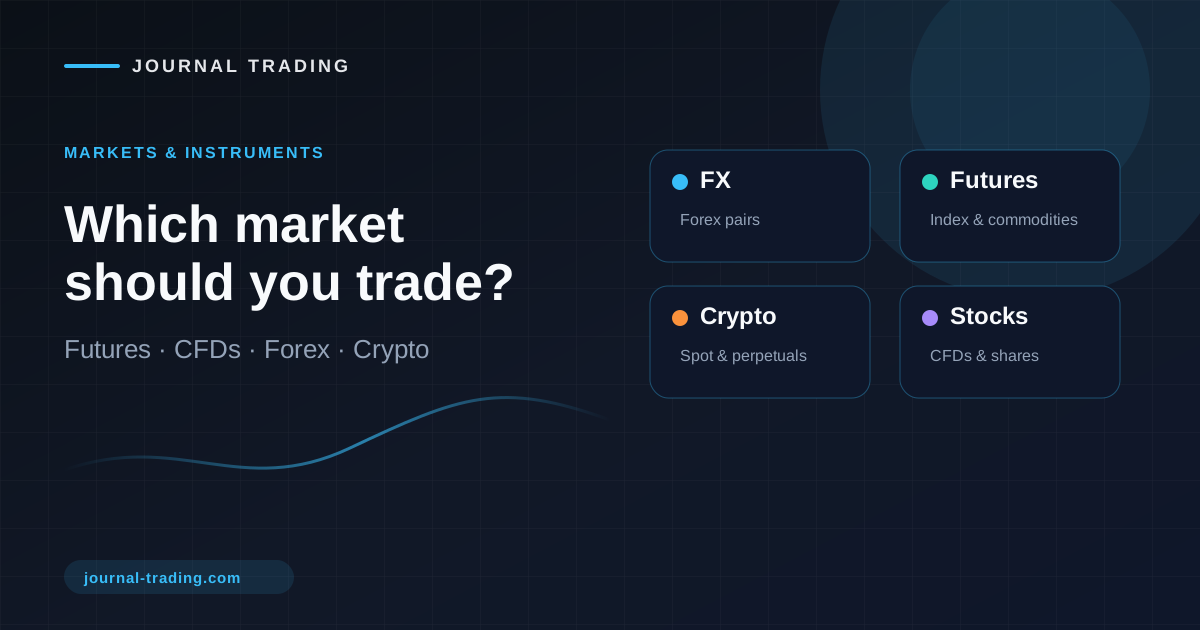
On spot, you actually buy the coin: no leverage (or limited margin), no funding, but buy and sell fees. On perpetual futures, you trade a contract that tracks the price with no expiry, with leverage and easy shorting. In return, a funding rate is exchanged regularly between longs and shorts (often every eight hours, depending on the exchange).
Always separate these two activities in your journal: their costs and risks differ.
Fields to record for every trade
- ▸Exchange and type: spot or perpetual, long or short
- ▸Pair (BTC/USDT, ETH/USDT…), entry and exit price
- ▸Position size and leverage
- ▸Liquidation price (perpetuals) and its distance from the stop
- ▸Entry and exit fees (maker or taker)
- ▸Funding paid or received while the position was open
- ▸Initial stop, risk in $ and as % of the account
- ▸Net result (after fees and funding) and result in R
- ▸Reason for the trade, setup, screenshot and emotion
Fees and funding: the hidden P&L
Take a $10,000 perpetual position. With 0.05% taker fees on entry and exit, you pay $10 per round trip. Hold it three days with 0.01% funding every eight hours and you pay roughly $9 more. On a trade that made $30 gross, nearly two thirds of the gain is gone. Real rates vary by exchange and market: record the exact amounts shown in your history.
💡 Using limit (maker) orders instead of market (taker) orders often cuts fees significantly for active strategies.
Leverage: think in risk, not size
Leverage does not set your risk: stop distance times position size does. A 20x trade with a tight stop can be less risky than a 3x trade with no stop. Set your risk first (0.5–1% of the account), then derive size with the position size calculator. Then check that the liquidation price is well beyond your stop.
The 24/7 market trap
Being able to trade at any hour encourages overtrading and fatigue. Record the time of every trade: many traders find that their night or weekend trades have negative expectancy. Set trading hours and a maximum number of trades per day, then check in your journal that you stick to them. Our trading psychology article gives simple rules.
Statistics to follow
- ▸Net result after fees and funding, per month
- ▸Win rate and average risk/reward
- ▸Profit factor and maximum drawdown
- ▸Results split by spot / perpetuals, long / short and pair
- ▸Share of fees and funding in gross result
The crypto trading journal computes these automatically. For the review process, follow our weekly review, and for the basics, our guide to the risk/reward ratio.
FAQ
Should I log long-term holdings? Keep them separate from active trading: they follow different rules and would distort your statistics.
How do I import crypto trades? Most exchanges let you export your history as CSV, which you can import into your journal.
What leverage should I use? Whatever lets you respect your risk with your stop, with liquidation far away. Leverage alone means nothing.