Crypto Trading Journal for Bitcoin, Ethereum & Altcoins
Free, no credit card required.
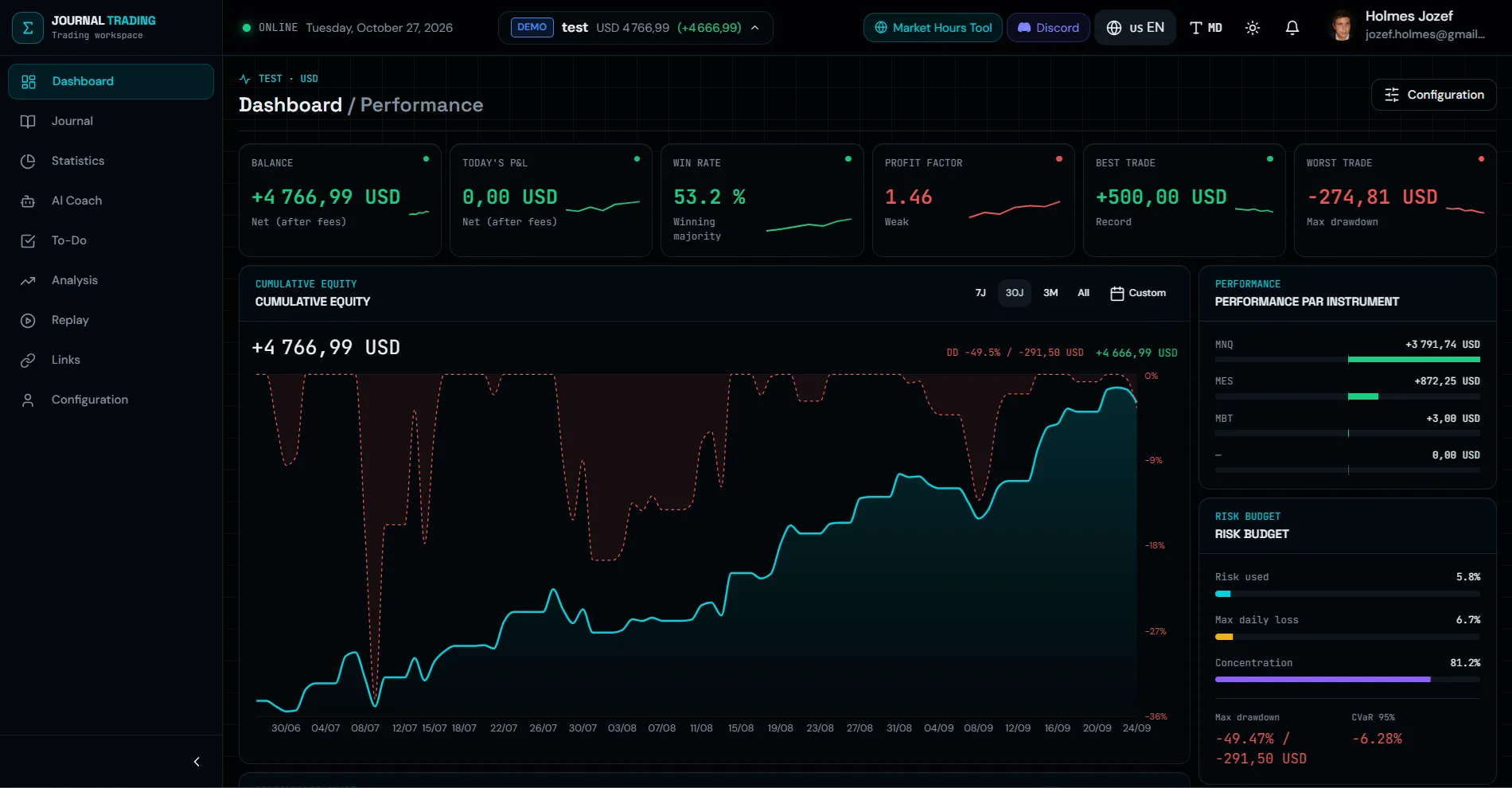
Log every cryptocurrency trade, see your true net P&L and find your winning setups. Journal Trading is the crypto trading journal built for digital asset traders.
What is crypto trading?
Crypto trading means buying and selling cryptocurrencies on an exchange to try to make a profit. Unlike traditional markets, the crypto market runs 24/7 and is often highly volatile.
Cryptocurrency
A cryptocurrency is a decentralized digital asset built on a blockchain. Bitcoin and Ethereum are the best known, but thousands of altcoins exist.
Crypto market
Cryptocurrencies trade on centralized exchanges (CEX) or decentralized exchanges (DEX). Prices are set by continuous supply and demand.
Trading pair
A crypto trade is done through a pair: BTC/USDT, ETH/BTC, SOL/USDC… The first currency is the asset bought or sold, the second is the quote currency.
Spread
The spread is the difference between the current bid and ask price. On less liquid assets it can be wide and impact your result.
Volume
Volume is the amount traded over a period. Higher volume usually means better liquidity and lower transaction costs.
Volatility
Cryptocurrencies can move sharply within minutes or hours. This creates opportunities but also significant risk.
Liquidity
A liquid crypto can be bought or sold quickly without moving the price much. Liquidity varies strongly between assets.
Long and short
A long position bets on a price increase. A short position bets on a price decrease. Spot trading buys the real asset; derivatives allow shorting and leverage.
How does a crypto trade work?
A crypto trade follows simple logic: choose an asset and pair, open a position, follow price movement, then close. The result depends on entry price, exit price, size and fees.
Choose the asset and pair
You choose for example BTC/USDT, ETH/USDT or SOL/USDC depending on your strategy.
Open the position at the market price
You buy (long) or sell (short) at the current price, with a defined size.
Manage movement and risk
The price moves. Your stop loss and take profit define your potential exit.
Close the position and calculate P&L
You close the position. P&L depends on the price gap, size and fees.
Concrete example with BTC/USDT
You open a long of 0.01 BTC at 92,500 USDT. The price rises to 95,200 USDT. The move is +2,700 USDT per BTC, or +2.92 %. On 0.01 BTC, the gross gain is 27 USDT before fees.
This is a gross calculation. Exchange fees and funding costs for leveraged positions reduce the net P&L. Journal Trading calculates the net automatically.
Why keep a crypto journal?
Crypto markets move fast. Without a written record it is impossible to know whether a strategy truly works over time. A crypto journal keeps every decision, result and context.
By reviewing your history you will discover which assets you perform best on, which sessions are most profitable, and which setups are worth keeping. It is the foundation of lasting improvement.
Journal Trading for crypto trading
Journal Trading is an online trading journal that adapts to cryptocurrencies. It automatically calculates net P&L, per-asset statistics and performance charts from your real data.
Crypto trade logging
Enter spot, futures or derivative trades. Each record keeps the asset, pair, direction, prices, size, setup and notes.
Detailed statistics
Net P&L, win rate, profit factor, max drawdown, average winner, average loser, expectancy and reward/risk ratio.
Performance by asset
Compare results across BTC, ETH, SOL and other altcoins to find what fits your trading style best.
Risk management
Track your exposure, losing streaks, average position size and adherence to your plan.
CSV and MT5 import
Import a CSV from your exchange or connect MetaTrader 5 through our read-only connector if your broker offers crypto trading on MT5.
100% free to start
Create an account, log your crypto trades and access core analytics with no credit card required.
Import your crypto trades
You don't have to type everything by hand. Journal Trading offers several ways to import your crypto transactions, whatever platform you use.
Your exchange or platform
Export your trade history
Import into Journal Trading
Analyze your performance
Supported import methods
- Generic CSV import with automatic column detection
- CSV files exported from major exchanges (Binance, Coinbase, Kraken, Bybit, OKX…)
- Read-only MetaTrader 5 connector if your broker offers crypto trading through MT5
- Manual entry for isolated trades or platforms that are not connected
Crypto trading statistics available
Journal Trading automatically calculates the essential metrics to evaluate your edge in cryptocurrency markets.
Number of trades
Total opened and closed positions for the selected period.
Win rate
Percentage of winning trades. Read together with reward/risk ratio and average volatility.
Profit factor
Gross profit / gross loss ratio. Above 1.5 the system is generally viable.
Max drawdown
Largest peak-to-trough decline in account value, shown as percentage and account currency.
Average win / Average loss
Compare the average result of winners and losers to calculate your realized R/R.
Performance by setup
Identify which strategies generate the most net P&L on your crypto assets.
Crypto trade charts and review
Charts make your capital growth and per-asset results visible. They help you review each session with hindsight.
Equity curve
Track your account balance day by day over the full account lifetime.
Performance chart
Switch between daily and cumulative P&L across 7D, 30D, 3M, 1Y and All periods.
Trade timeline
Review every trade on a timeline with its winner/loser marker.
Performance by asset
Visualize which cryptocurrencies contribute most to your overall net P&L.
P&L analysis preview
Sample data for illustrationCrypto trading journal template
A good crypto journal follows a repeatable format. Here are the fields to fill for every trade so you build a solid analysis base.
| Field | Example | Why it matters |
|---|---|---|
| Date | 2026-01-08 | Lets you filter by session and month. |
| Asset | BTC | Identifies your most profitable assets. |
| Pair | BTC/USDT | Splits performance by trading pair. |
| Direction | Long | Checks whether you perform better long or short. |
| Entry | 92,500 | Calculates your average entry price. |
| Exit | 95,200 | Determines the gross result of the trade. |
| Size | 0.01 BTC | Quantifies exposure in asset units. |
| Stop loss | 91,500 | Measures stop placement quality. |
| Take profit | 98,000 | Evaluates planned risk/reward ratio. |
| Fees | 0.18 | Subtracts platform costs. |
| Net P&L | +26.82 | Gives the final P&L usable for statistics. |
| Setup | Resistance breakout | Lets you analyze which setups work. |
| Notes | High volume before breakout | Keeps market context for review. |
Crypto trading journal Excel vs dedicated software
Excel: flexible but demanding
- Fully customizable
- Formulas and pivot tables possible
- No extra cost if you already own a spreadsheet
- Very time-consuming manual entry
- Risk of formula errors
- Hard to maintain with hundreds of trades
- No automated analytics or interactive charts
- Manual conversion and aggregation across multiple exchanges
Journal Trading: automated and built for crypto
- Smart CSV import with column detection
- Automatic net P&L, profit factor and drawdown calculation
- MT5 connection to sync closed positions
- Charts by asset, pair and time period
- Access from any device
- No formulas to maintain or files to back up
Free crypto trading journal
Journal Trading is free to get started. You can create an account, add one or more trading accounts, import your crypto trades and access core statistics with no credit card.
Start for freeNo commitment, no card required.
Crypto Guides
Go further: our guides to journal your crypto trades and manage your risk.
Crypto trading journal
Tracking spot, perpetuals, fees and funding.
Read the guideRisk/reward ratio
The key to trading profitability.
Read the guideHow to keep a trading journal
What to record and how to analyze it.
Read the guideBest free trading journal
An honest comparison of free journals.
Read the guideTrading other markets?
Journal Trading supports several asset classes. Explore our resources for Forex and Futures.