Forex Trading Journal for All Currency Pairs
Free, no credit card required.
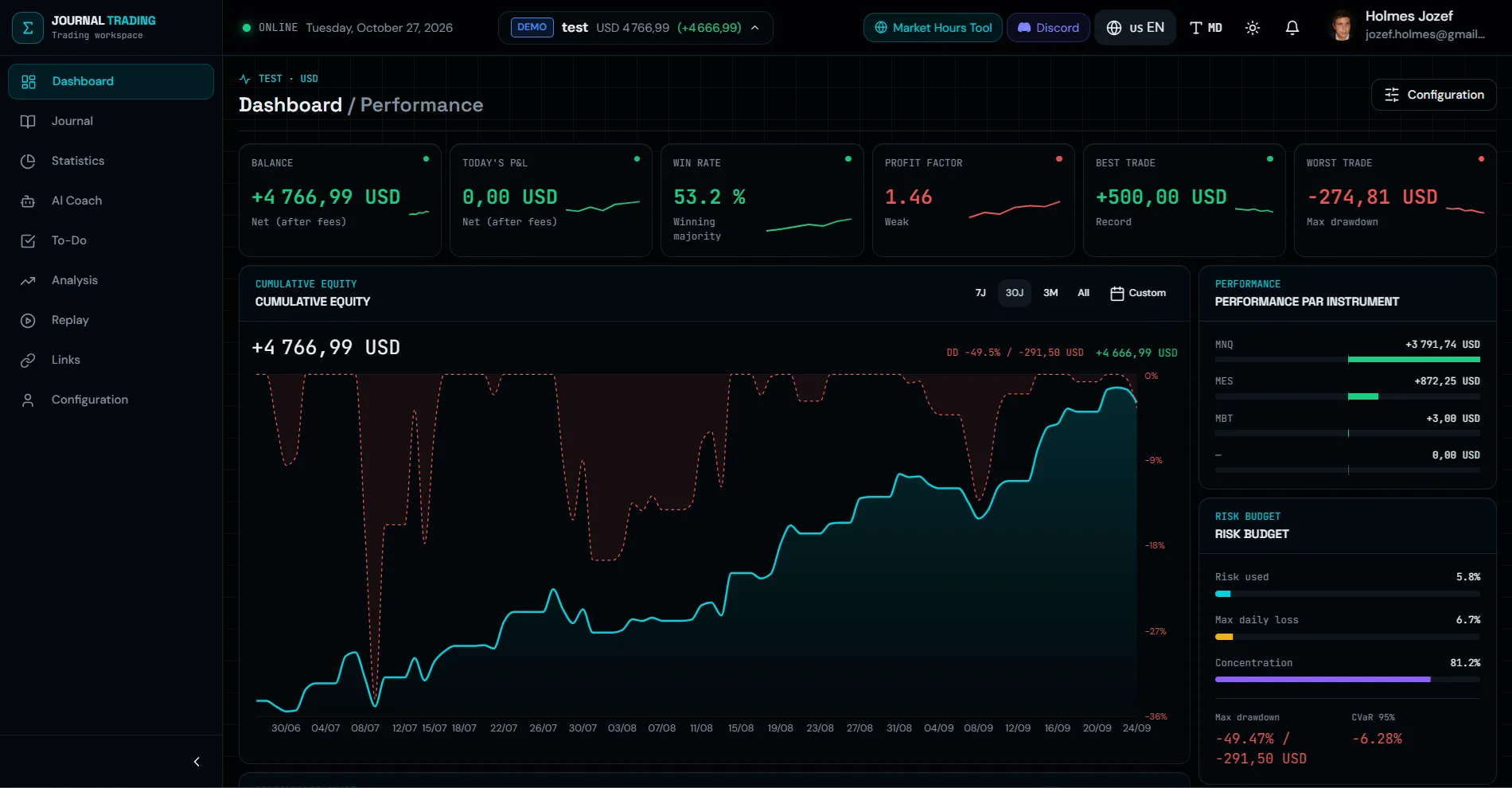
Log every currency trade, see your true net P&L and find your edge. Journal Trading is the forex trading journal built for traders who want facts, not feelings.
What is the Forex market?
Forex (Foreign Exchange) is the global market for currency trading. Currencies are exchanged in pairs, 24 hours a day from Sunday evening to Friday evening. It is the most liquid market in the world, with daily volumes above 7 trillion dollars.
Currency pair
A pair compares two currencies. EUR/USD means you compare the euro to the US dollar. The first currency is the base currency, the second is the quote currency.
Base and quote currency
If EUR/USD is 1.0850, one euro equals 1.0850 US dollars. Buying the pair means betting the euro will rise against the dollar.
Bid and ask
The bid is the price at which the market buys. The ask is the price at which it sells. You buy at the ask and sell at the bid.
Spread
The spread is the difference between bid and ask. It is an invisible but real cost every time you open a position.
Pip
A pip is the usual smallest price move. On EUR/USD it is 0.0001. On yen pairs it is 0.01.
Position size
One standard lot equals 100,000 units of the base currency. Mini, micro and nano lots let you reduce exposure.
Leverage
Leverage lets you control a larger position than your capital. It magnifies both gains and losses, so risk management becomes essential.
Long and short
A long position bets on a price increase. A short position bets on a price decrease. Both directions are available in Forex.
How does a Forex trade work?
A Forex trade follows simple logic: buy or sell a pair, then sell or buy it back later at a different price. The difference between entry and exit determines your profit or loss.
You open a position on a pair
For example, you decide to buy 0.10 lot of EUR/USD at 1.0850.
The price moves for or against you
Minutes or hours later, the price moves to 1.0880 or 1.0830.
You close the position
You close your position at the current market price.
You calculate the net result
Result = (exit price − entry price) × position size.
Concrete example with EUR/USD
You open a long of 0.10 lot at 1.0850 and close at 1.0880. The move is 30 pips. On EUR/USD, one pip is roughly $1 for 0.10 lot. This trade makes about +$30 before fees.
Why keep a forex trade journal?
Memory is biased. After a losing streak you forget your mistakes. After a few wins you overestimate your edge. A Forex trading journal is an objective tool that keeps every decision, result and context.
Reviewing your history reveals recurring patterns: which pairs you perform best on, which hours cost you money, and which setups deserve to stay in your plan. It is the first step toward lasting progress.
Journal Trading for Forex
Journal Trading is an online trading journal built to log, analyze and review your Forex trades. Every feature is based on real data and accurate calculations.
Detailed trade logging
Enter trades manually or import them via CSV. Each record keeps the instrument, side, prices, quantity, setup and notes.
Performance statistics
See your net P&L, win rate, profit factor, max drawdown, average winner/loser and other essential metrics.
P&L calendar
Visualize winning and losing days on a color-coded calendar to spot your performance cycles at a glance.
Risk management
Analyze your exposure, losing streaks and sizing consistency to keep your risk under control.
Automatic MT5 import
Connect MetaTrader 5 with our read-only connector. Closed trades are synced automatically with no manual entry.
100% free to start
Create an account, log your trades and access all core analytics with no credit card required.
Import your Forex trades
You do not have to type everything by hand. Journal Trading offers several ways to bring in your transactions, whatever broker or platform you use.
Your broker or platform
Export your trade history
Import into Journal Trading
Analyze your performance
Supported formats and platforms
- Generic CSV import with automatic column detection
- CSV files from brokers such as Tradovate, NinjaTrader, TradeStation, Interactive Brokers and Rithmic/TopStep
- Read-only MetaTrader 5 connector for automatic synchronization
- Manual entry for unique trades or non-connected accounts
Forex trading statistics available
Numbers do not lie. Journal Trading automatically calculates the most useful metrics to evaluate your edge in the currency market.
Number of trades
Total opened and closed positions for the selected period.
Win rate
Percentage of winning trades. Always read together with the reward/risk ratio.
Profit factor
Ratio of gross profits to gross losses. Above 1.5, a strategy is usually considered solid.
Max drawdown
Largest peak-to-trough decline on your equity curve, shown as percentage and account currency.
Average win / Average loss
Compare the average size of your winners and losers to calculate your realized R/R.
Expectancy
Average gain or loss per trade. Positive expectancy means a statistical edge.
Forex trade charts and analysis
Charts make visible what raw numbers can hide. They show your capital growth, your gain/loss distribution and your performance by currency pair.
Equity curve
Track your account balance day by day over time.
Performance chart
Switch between daily and cumulative P&L across different time periods.
Trade timeline
See every trade on a timeline with its result as a winning/losing marker.
Performance by instrument
Identify which pairs make you money and which ones to avoid.
P&L analysis preview
Sample data for illustrationForex trade journal template
A good Forex journal follows a simple, repeatable format. Here are the fields to fill for each trade so you build a solid analysis base.
| Field | Example | Why it matters |
|---|---|---|
| Date | 2026-01-08 | Lets you filter by session and month. |
| Pair | EUR/USD | Identifies your most profitable pairs. |
| Direction | Long | Shows whether you are better at buying or selling. |
| Entry | 1.0850 | Calculates your average entry price. |
| Exit | 1.0880 | Determines the gross result of the trade. |
| Size | 0.10 lot | Calculates real dollar risk. |
| Stop loss | 1.0830 | Measures stop placement quality. |
| Take profit | 1.0910 | Evaluates planned risk/reward ratio. |
Forex Excel trading journal vs dedicated software
Excel: flexible but demanding
- Fully customizable
- Formulas and pivot tables possible
- No extra cost if you already own Office
- Time-consuming manual entry
- High risk of formula errors
- Hard to maintain with hundreds of trades
- No automated analytics or interactive charts
Journal Trading: automated and built for traders
- Smart CSV import with column detection
- Metrics and charts calculated automatically
- MT5 connection for real-time sync
- Access from any device
- No formulas to maintain or files to back up
Free Forex trading journal
Journal Trading is free to get started. You can create an account, add one or more trading accounts, import your trades and access all core statistics without a credit card.
Start for freeNo commitment, no card required.
Forex Guides
Go further: our guides to understand pips, choose your platform and manage your risk.
Trading other markets?
Journal Trading supports several asset classes. Explore our dedicated resources for futures and crypto.